4/17/21

10 Things I Love About 10 Things I Hate About You


It was Heath Ledger, not exactly him but his strikingly-handsome Aussie accent, which made me watch 10 Things I Hate About You last week. But even before that last-minute decision, there's already a few signs lurking here and there, somewhere lowkey, across my consciousness, that was telling me to go and watch it. 

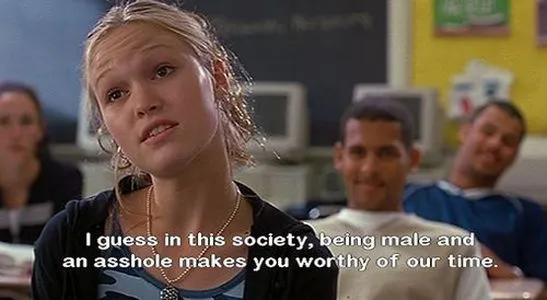
The first sign was probably when I was dead scrolling through Twitter. It was a weekend afternoon and I was set to slouch in and do something unproductive. This only means that I can switch from one application to another and just keep scrolling aimlessly until I could finally feel my eyes shedding tears on its corner. But that day I was not crying when I was stopped by this retweet of a follower of mine. There was no actually a comment above the post but just pictures of that scene in 10 things I Hate About You which have captions on it. But, no, it was not that caption particularly that has me convinced to at least be curious about it. It was the eyes of Heath Ledger, I don't know, but there was something in that eyes... and on that scene which I just had a glimpse at first on that retweeted post, I felt it was not just a lame and formulaic clichΓ© film. However, despite the telling eyes of that guy, I was not able to watch it still. I was not yet in that right mood. So hours passed by without notice and I was already in my bed. I was lying there hopelessly and it was night already and I haven't decided yet on how I was going to spend the remaining hours until midnight. Friday is still the best day to sleep late without pressure because Saturday means one day before the Sunday which is the day before weekdays. Damn, I loathe Monday that much!

Anyways, since I finished being bored with Instagram, I decided then to surf through YouTube. I was welcomed with bunch of videos about random stuff which I just watched without clicking it actually. I just really consume it that way now, not bothered about having it no sounds. It was not really long after when I was stopped again by a thumbnail of a familiar video. Yes, it was Heath Ledger again behind a striking text in front that says "Patrick and Kat something". I could not remember the whole exact text. And since, it was already night and I was already in the mood to finally focus on something for a longer duration, I decided to stimulate my growing curiosity by clicking the video. There, I saw few clips, one of which, was that scene I saw from that retweeted post on my Twitter feed. I have liked the scene... and Heath Ledger's eyes. So then, the next thing happened, I was already enjoying the film from the start unto its last minutes. 

Admittedly, I was not a fan of any teen romance-comedy film. I could not even name any of which that is a no-brainer for everyone. I am not sure as well if ever I already watched one and if ever I do, I could not remember anything at all. Any film that falls under that category, I find them usually smarmy and half-baked in a deliberate sense. I am guilty also to admit that the story is lacking but conscious enough to push through its same old plots which are being traded around with other films of the same genre. I guess that could be the reason why I rejected that moment three or fours years ago when I already consumed the twenty-minute run of 10 things I Hate About You but then decided to quit because I thought I would not like the show. 

To set things straight and honest, I thought it was lame and cringey. To soften the blow, I was wrong for thinking that way all these years of not trying to watch it first. Perhaps, I have already watched such films of that genre, but those might have just passed by my memory the moment I finished watching it. But with 10 Things I Hate About You, I had a different experience. I could not deny that the story was predictable but since I was watching an old school movie and it was a romantic comedy, I understood that I should not expect it to be that philosophical or complex. However, I was taken aback sometimes with their dialogues. They sounded like they were reciting lines from Shakespeare's drama, which is partially true since I learned after that this film was drawn from the story of The Taming the Shrew which I have been hearing a lot on school when I was still studying but too lazy enough to read it. After giving it time to grow on me, I did not expect that I was already halfway watching it and was silently enjoying it already. This film might not be the best in terms of plot-wise but for some weird reason the scenes that I thought I would flinch at were actually the scenes that I mused on. I never thought, as I watching it, that I would buy its humor and sometimes clumsy sequence. To be honest, I did not only buy it once but twice and was inclined then to do it one more if only I did not come across an American comedy series which I am currently watching as of writing.

10 Things I Hate About You was a 1999 film, a year older than me. It felt weird watching movies older than me because one of the things I could think about is: I haven't born yet when it was released. And enjoying it despite the gap and whatever it entails with is very cool for me. Of course, I did not come to like it for no obvious reasons. This film might not be different to a myriad of rom-com films but it is an all-era appropriate. It can stand the test of time and can still be as effective to youngsters of each coming generation perhaps. 

The actors are all likeable. 

I like it that they did not make the character of Patrick overtly a bad boy. He is mischievous but not to a fault. It was great seeing such characters that are not forced to embody excessively what they are supposed to embody. With Patrick, he dresses up like a bad boy but he is not exactly rude and someone who beats up people for the sake of his image. I apologize right now if I will mention again his Aussie accent because I really have to, it's flawless!

Initially, it was Heath Ledger who invited me to watch this film. However, it was Julia Stiles who made me stay until the last minute. She has a conviction to her role and does justify the character she has to play. I like her snotty expression and even the way she delivers her sarcasm. She knows herself and is aware of her capabilities. But more than that, I even like her more on her progression towards the latter parts of the story. It was her, that moment when she was reciting her poem, that significantly hold the film more steady. She was the game changer and she was Kat Stratford. 

Can I say how cute was the young Gordon-Levitt? However, I could say he was kind of as characterless as his other half Oleynik. How I wish their characters were explored more especially Gordon-Levitt's because he is more than beyond his romantic pursuit to Bianca Stratford. While with Bianca, I wish she was explained as the girl who is dressed strategically in a summer dress and not only displayed like that. She is young and cute but whenever I try to recall her in the film, I see more of her wanting to be involved for the sake of normalcy as a teenager. I also want the idea that like Kat, audience will also be informed of her dreams and her inner struggles which were not showed sadly until the ending. 

Overall, I was really taken aback by how effective this film was for me. Since 10 Things I Hate About You is an old film, there are already films with the same cliched storytelling which I watched first before it and did not like. I felt those lack vital sparks which I have surprisingly seen in this film. There are scenes that I would have flinched and cringed at but it was bought because the characters were likeable to me. They had the energy that I like and despite that it was predictable it still worked on me. This is the kind of film that would not exhaust you to think of the impossibilities but would like to settle you in a fun and lively ride where you would just watch it comfortably.

This film is loveable. You don't have and can't think about 10 things to hate it. Instead, all I could think about is the 10 things I love about this film.

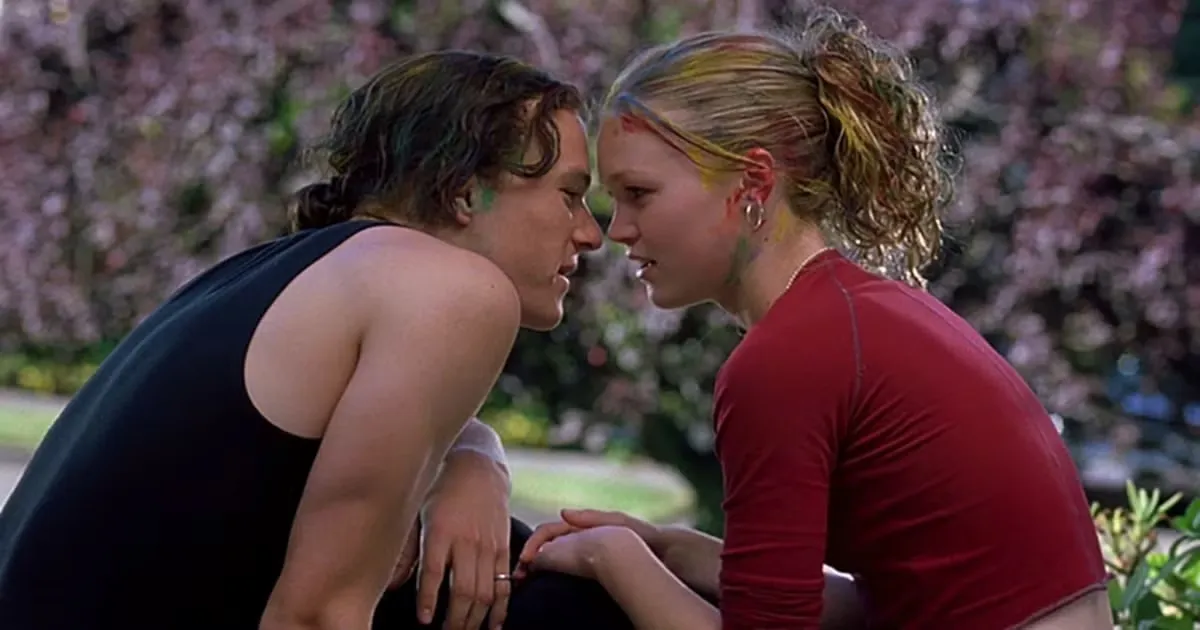
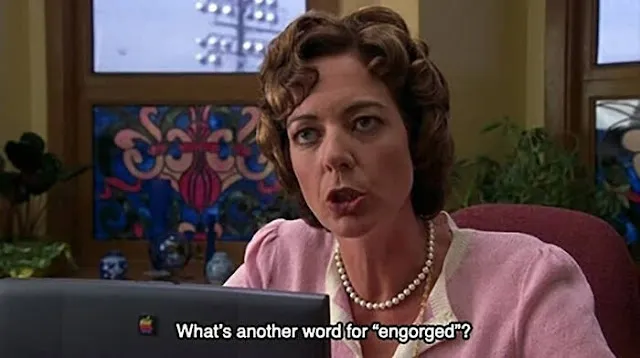
1. One of the first appearances in the film was her. She was looking in all seriousness at her screen and I thought she was a stern woman. And I was right, I just thought. 

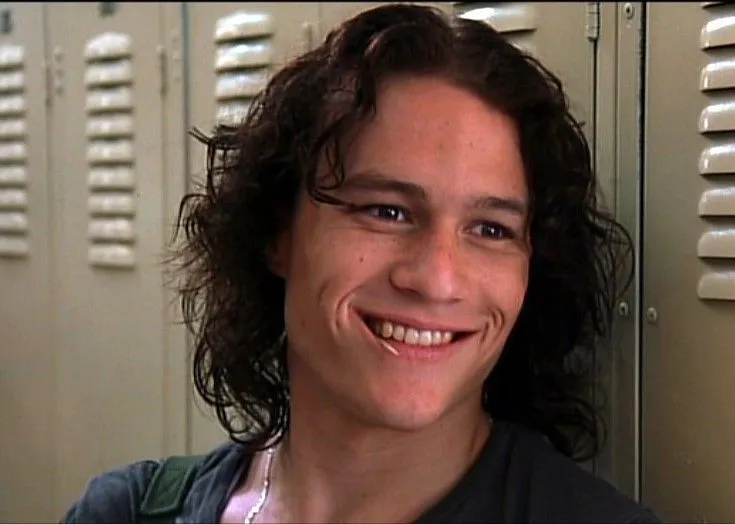
2. Look at that smile! This was the moment I was convinced that he...


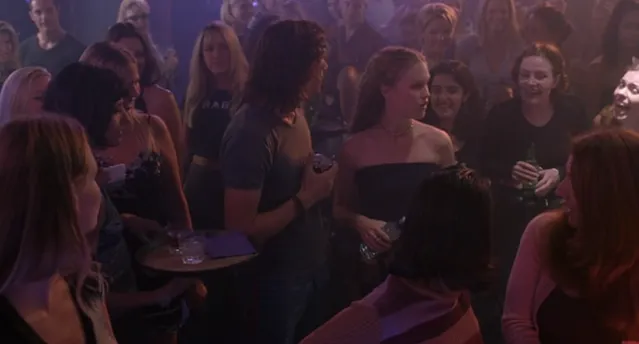
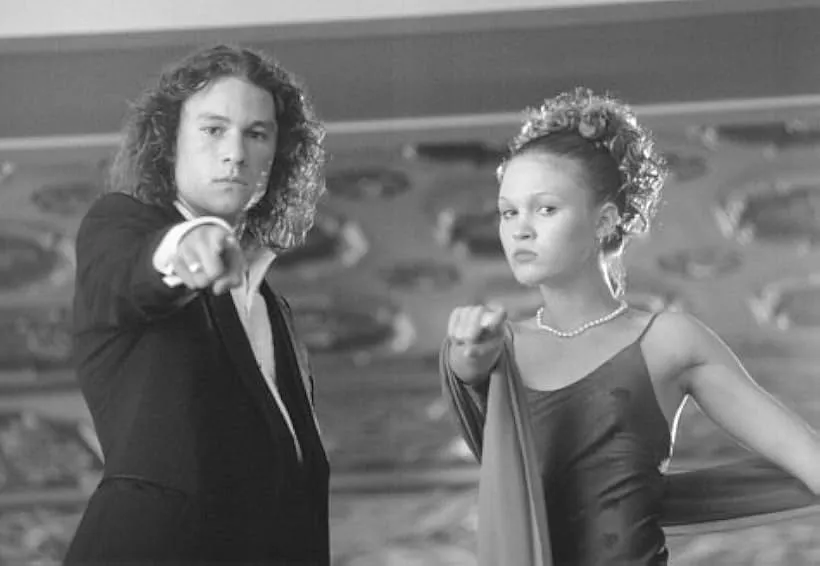
3. When Patrick spotted Kat in the crowd– dancing and feeling herself, I agreed with him when the music paused and everyone heard him realized that she was sexy.


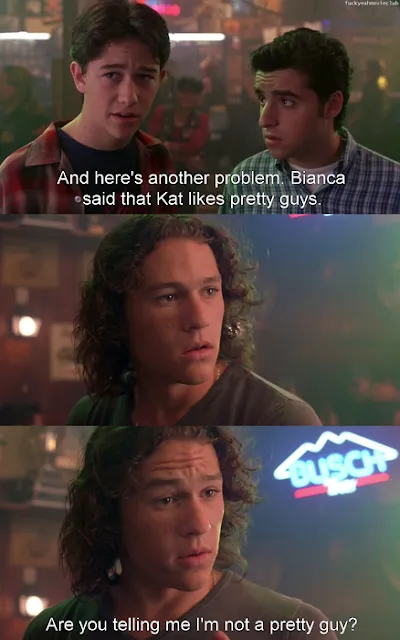
4. I laughed here when Cameron and his friend told him the bad news that Kat Stratford was into pretty guys. The pause, his thinking, and his serious question to them, "Are you telling me I'm not a pretty guy?" that probably hurt his pride. 

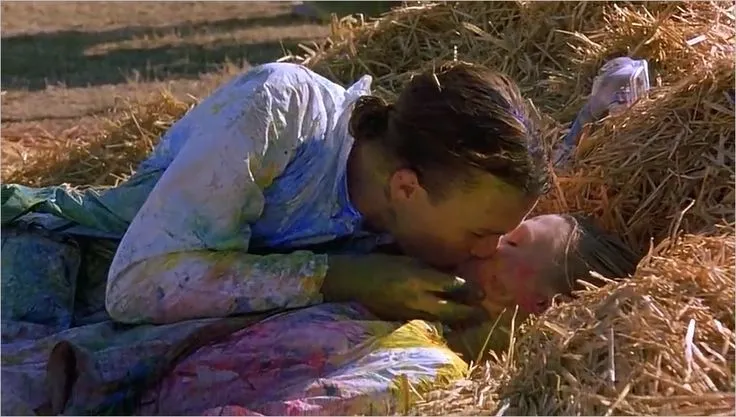
5. Uhm?

6. When Heath Ledger appeared on this scene with his hair tied, I was impressed by how pretty he was there.


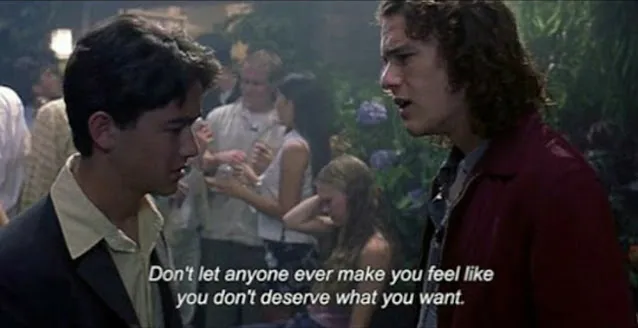
7. I was surprised here. After Kat wildly danced her way on the table and everyone was bewildered, Cameron asked Patrick to chat for seconds. While still cautious to Kat who's then dizzy, Patrick talked to Cameron for the first time with a serious tone. It was I think the first time also he showed that glimpse of himself. 


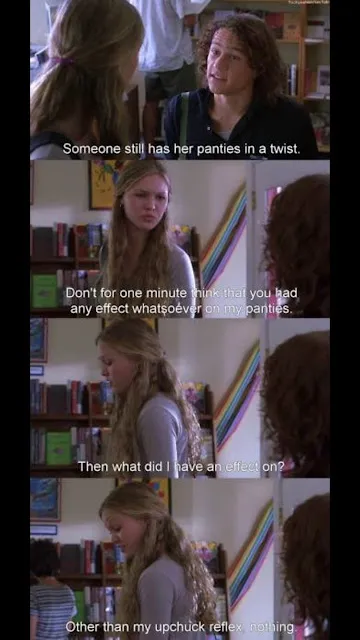
8. I like this scene, also the ones prior to this very moment. He was silently tracing her way while there's music playing in the background. But in here, I like the exchanges of their mockery and sarcasm. Kat obviously won here. 


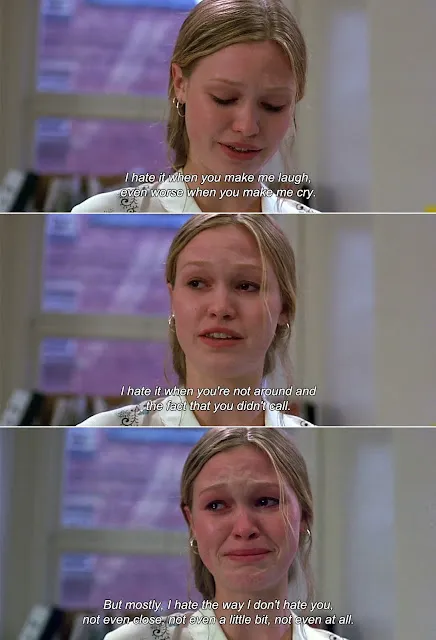
9.  This is the game changer I was talking about. The feels!!! This scene was the first time I saw her cry and realized that she was hurt but then still sincerely in love with Patrick. I love the poem!!!


10. That's on periodt, periodism, periodicity, periodically, periodic table.  


Share:

4/10/21

The War of Translation: Colonial Education, American English and Tagalog Slang in the Philippines

The War of Translation: Colonial Education, American English and Tagalog Slang in the Philippines by Vicente Rafael

A Once Written Report


Let's say, I have two friends; However, the years that I have known them separately varies in span of years. For example, this Friend Number One, has been my friend for three years already; Whereupon, this Friend Number Two is my "childhood" friend.

When we become friends to someone, in a way, we acquire the way they talk, their gestures, mannerism, even the way they look at things in perspective. So, basically, it is more natural to assume that between these two friends I have, I am much closer to Friend Number Two. From a stranger's perspective, they would possibly connect the fact that, since she is my childhood friend, I have a longer history of friendship with her compared to the former. That’s, most of the time, how it is: The longer you know the person, the bigger the chance for anyone to jump into conclusion that we are much closer. Thus, we have a stronger bond, and might have a bigger tendency to be alike. In conclusion, I am assumed to be much closer to the one whom I have a long history with.

BUT in the case of American and Spanish occupation here in the Philippines, it’s the opposite. We have been hearing it a lot as we were growing up. The Americans ruled our country for 41-year span of time. It was long, but not that much with the Spaniard's, whose occupation here lasted for 333 years. (And goodness, if it rather extended double its years, Judas must have been over the moon once the Spaniards are prepping already for their 666th day in the Philippines.) With these years of domination, no one could have actually thought that it was ironically the Americans who successfully invaded our country. Looking at their numbers, Spaniards won obviously, however, Filipinos might have some kind of allergy to any kind that reminds them of Mathematics, that's why, it was the American's fist that was seen balled up towards the air. With the analogy above, we could say, it's not always about the long years but also the effectivity of one's influence over something. And one easy example that was already mentioned is the America's long-standing domination--even up to now --particularly their "master stroke" of colonial education here in the Philippines. The article that I am using for this blogpost is Vicente Rafael’s The War of Translation: Colonial Education, American English and Tagalog Slang in the Philippines.

Vicente Rafael is a professor of Southeast Asian history at the University of Washington, Seattle. He was trained in Southeast Asian History of which much of his writings were concentrated on the colonial and post-colonial state of the Philippines and the United States. Before I graduated in college, there was once a written report that we were asked to do for our final requirement on this subject. Initially, I wanted to simply talked about Pinoy slangs, however, there were few among us who already used the topic and I wanted to take a detour from that commonality. While browsing, and I remember that exhaustion I had that day, I finally came across this article which I could not recall where I saw it. It was long but I kept reading it hoping that at least I could just find ideas that could help me decide for my topic. In the article of The War of Translation: Colonial Education, American English and Tagalog Slang in the Philippines, I stumbled upon this word "Filipinization" from its subtopics. When I heard it, I searched it online immediately.

Upon learning what Filipinization was, a recent memory from my freshman year popped out of my mind. It brought me back to that book entitled "Komunikasyon sa Wikang Filipino" which we had to purchase since our Filipino professor was one of the authors of that book. From our early exercises, I was caught off by this strange Filipino word that was not really not a Filipino word to begin with. They are actually English words, however, it is spelled in the way we, Filipinos, pronounce it.


Let me provide few examples:

"Computer" is the word, but in the book, it is spelled as Kompyuter;
"Science" as Sayans; "Picture" as Piktyur and etc.


At first, it was strange reading it. I even questioned why the authors write those words that way as if those words don't have their respective equivalent Tagalog words. I am not sure about computer, but I know "science" is translated into "Agham" and "Picture" is "Larawan". So, what's the motive or intention of the book?

I even sneered at my professor for thinking that she was teaching us something weird and thus wrong. But then I also realized while I was doing this that they were not the one who invented that process of spelling out English words and this deliberation has a significant telling to us. And with the article I used, Mr. Rafael termed it as Filipinization of English.

According to the article itself, created as a counterinsurgent response to the Philippine-American War, colonial education seeks to train colonized subjects in a different sort of war and we might think of this as the war of translation.

The pursuit of this war aimed at the conquest and colonization of languages, both the vernaculars and English. So the cycle started with the Thomasites who would train the Filipino teachers to speak English so they could pass it on to their students. Contrary to this cycle, only practically half percent of the population learned English and could also read and write using this language. The destruction that came caused by the wrath of war has changed many things which destroyed also the cycle that the Americans initially wanted to pursue.

Most of the native English teachers and non-native English teachers died during the war. Some of them lost their professions because they did not return to their classrooms when the war came to an end. Since the spoken language is learned through imitation by native speakers of the language, the lack of native speaker models has affected certain sounds as enunciated by English-speaking Filipinos today. Our English now is becoming vernacularized which we are now called the Filipinization of English.

The very attempt to teach English simply in-flamed the resistance of native languages. Hearing the teacher's English, students followed. And doing so, they were misled, perhaps according to the sensitive ears of the Americans-- that instead of ending up on the road to phonetically correct American English, they were misdirecting to the "strange" and "unintelligible" zone of its Filipinized version.

So, "Filipinized English" is like dressing English in the clothes of "Malay" sound pattern. They see the in foreign the recurrence of vernacular, not its demise. To translate in this case required not the suppression of the first (our language) for the second language (English language), but an alertness to the sound of the first retracing itself around the appearance of the second. Thus, the mother language insinuated itself into the foreign one.

I know that one important linguistic phenomenon in Filipino is the rule: Kung ano ang bigkas, siyang sulat. And I think it is a lot easier to write a word the exact way we pronounce it. I mean, no sweat at all. However, there are some exceptions that we have to consider.

So, why the authors of that book I mentioned used “sayans”, “piktyur” and other Filipinized words if they can be translated in the first place.

After some deliberation. I came up with possible but not really strong reason behind their usage of Filipinization on English words.

Is it because of the so-called “resistance”? That despite, according to the article, in the hands and on the mouths of Filipino, English can be a language for accommodating, or at least, signaling the insistent presence of what is supposed to be excluded and overcome.

Is it because we are physically attuned and mentally habituated to our mother tongue's intonations, referents, and rhythm?

Conserving the foreignness of English also meant making room for the recurring traces of the vernacular. For an example, there are some Filipinos who are great in English however they still struggling with pronunciations. Of course, people who was raised and grew up in an English-speaking household or abroad are excluded. The people I have in my mind are those whose English command is just introduced in an educational setting with minimal exposure from the language. You can notice how one can really be good in the nature of English but will struggle at first with the pronunciation of the words. Instead of speaking it like the Natives, even with years already of exposure, they pronounce it like how they do in their vernacular. It is like they are wearing an English clothing in a Filipinized material. (Am I making sense?)

If we see it on a deeper sense, perhaps this could be a silent revolt of the dominating English language. They could dress our language with theirs, but our nativeness will remain on itself and it will not be just changed because of some ornaments and foreign weavings of strangers' hands. Its essence remain as it is.

Or because Filipinos believe that there is never an end in creativity especially in the use and structure of language?

Or is it because we have a symptom of the dismal limits of colonial policy and evidence of the racial incapabilities? Which, I would definitely disagree with.

Share:

In chaos, that's where...


He's on the stage,
and they can feel the magic.
His silhouette glows against
the frisky, tight arc of lights,
the center of his musical space
dimmed by the smoky hues
of passionate breaths.

A cacophony of deafening sounds erupts:
stereo melodies living in their ears,
the impassioned gusto of instrumentals
enduring their fleeting incapability,
jarring voices echoing through the crowd,
and the commotion of thoughts in their heads
(the ones they keep forcing back
into some semblance of order).

But they’ve always been here—
comfortably,
or maybe because they’ve grown used to it:
the chaos,
where the scent of sweat mingles
with collective urban gasps
of weary, depressed souls.

The melody of his voice
echoes their experiences—
the brokenness,
the confinement,
the weight of mental exhaustion.

And when he reaches out,
touching the air,
his gaze fixed somewhere between
the void and the burdened sea of eyes,
they feel
escaped.

He whispers his song;
they exhale their agony.

This is the art of solitude.

Lost in the crowd—
not apart,
but alone,
together.

They defy the world.
They fixate on something unseen,
hearts skipping in sync with the pulsing stereo.

He bangs his head,
and they sway theirs with abandon.
He leaps higher,
and their spirits rise with him.
The music crescendos, deafening,
lungs heavy with euphoria.
Lights blink,
momentarily blinding their weightless eyes.

That moment—a fragile line—
they’re suspended
between emptiness and depth,
living in two worlds at once:
the slap of reality,
and the rush of fantasy.

Share: