Whenever I get the feeling of watching something again, there's always a tinge of uncertainty that comes along the same moment. Like last month, I felt like I had been a bum for wandering up aimlessly on Netflix for almost some time. I was literally doing nothing but scrolling here and there on the platform and always ended up lost in the long run of searching. I was not exactly planning to consume another Korean drama series since I already did it with One Spring Night which I never intended but just so happened that it was followed not long after then by Once in a Summer. I actually considered the thought of exploring some other Asian films especially a Taiwanese film, however, I could not find any among the bunch that could match my mood well at that time of drought.
Basically, I was like on a trial-and-error phase for days. This could also mean that for days I was sleeping my worries away for hardly settling on something to watch. I was not sure if I was just extra picky at that time and was delusional for expecting that the film I wanted to watch will unfold a spectacular scene the very moment it starts. Thus, I decided to just maybe stretch my patience out and give the film that I would watch more time to roll by without the constant pauses of hesitation. After scrolling with the hopes of stumbling upon something, I came across this Korean period drama which I had seen already before but had never actually been interested to see. However, at that time, I clicked it without much conscious thought. The preview automatically played but I decided to further watch some of its clips on YouTube just to know something a little more of this drama. So, after some little exposure from it, I finally decided to watch The Hymn of Death.
The moment the series started, there's no really such an exaggerated feeling of discovery, but just a slight nod of acknowledgement. As of writing, I could still recall flashes of image on its pilot episode. Within few seconds already rolling by, I could say I was open still on the possibility that I might back out if ever it will not stir even a slightest interest in me. And surprisingly enough, it actually did.
The film has a bleak image. It opened in a moving ship swaying across the calmness of the ocean. There was a patrol guard on duty, checking each pole of the vessel through the reach of his flashlight. On the top of that scene, the opening credits vaguely flashing by whenever the camera passed by a wall while still following the guard who was then being pulled by the distinct humming lullabies from a phonograph. I should not forget to note how I initially hooked by the camera movement specially when it zoomed out from the back of the patrol guard. From that scene, I was slowly and already getting the groove of the drama just like how the ship was sailing stilly in the course of night without probably anticipating what would unfold thereafter. The patrol guard stopped by an open room. The vinyl playing was the only thing there with life, the rest seemed undisturbed. After turning to another direction, the guard spotted a note beside the suitcase.
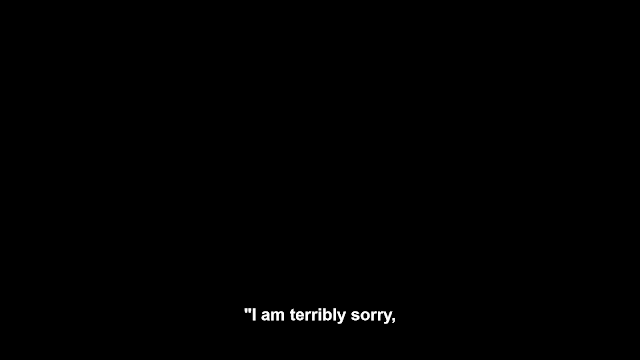
There, I already felt a heightened sense of foreboding. The note was not a plain apology but a foreshadowing of what has already happened by the time it dawned on him what was the note telling him. With enlarged eyes, he stormed out the room and went straight to that part of ship wherein he was stopped by the still-like image of two pairs of shoes both aligned to the direction of the comely ocean.
Tracing the phonograph, the note, and the shoes, I thought about the possibility that they both wanted it. The phonograph was playing invitingly, like it was left there playing on its own to draw anyone to the direction of the open room where it was at. Without it, probably, the guard would not locate the note left beside the suitcase. It was placed in a perfect spot to glance upon, as if it was there to be discovered because it had to. Also, it was not even wrinkled, but on the paper, it had there an inky stamp of someone's fingerprint. The way it was written was so casual and composed. It did not evoke even a sense of remorse nor regret, but just a casual apology for leaving such kind of inconvenience to a stranger. And when the patrol guard spotted the pairs of shoes, it was unnaturally aligned. One could have thought that no one attempted to jump off the vessel, however, it was an ocean, and the chance of getting out of their alive was improbable. In addition, no one would definitely jumped into there, unless, they wanted to end their life. Despite his fright, the patrol guard collected his grip and still managed to blow his whistle which then echoed throughout the silence of the night. Perhaps, on their sleep, no one thought that in the midst of it, there were two lovers who were wakeful. And only the pretentiously calmed ocean witnessed their freedom.
After I finished the few episodes of The Hymn of Death, I was left unfinished. I was bombarded a lot with my own wonderings, that's why, for days I had been pondering about their story and the many things that could have happened if only this and that did not happen. What added up more is the fact that I was not aware that the episode I finished watching was already its finale. And although I know everything on its last minute until its ending made sense, I felt like I was still gasping for another queue of episodes, and I was not ready yet to finish their story because the drama had already put me at the peak of anticipation, only to find out that I was still hanging even it was already ended.
I also found out that The Hymn of Death was inspired by true-to-life events although I was not sure if it has been accurately depicted in the drama. Since it was hard to trace the life of both Kim u-Jin and Yun Sim-Deok due to the limited resources, I will just then set my focus on the drama itself.
There were a lot of striking scenes throughout the course of my watching experience, however, what caught hold of me, was the very few mentions of name of this Japanese novelist. The first time I heard of him, which I failed then to recall immediately (so, I had to re-watch that scene), was when Yun Sim-Deok stepped in the room carefully. As she walked further, there revealed the sightly view of a man who's front onto the sunlit window. He was immersed, and his conviction in every read word, was calm. As soon as he finished reciting the poem, he was caught by the unwelcome voice of a stranger who then mentioned the man behind the poem he was reading: Takeo Arishima. I did not take note of his name. I thought he would just passed by. Not until when I was on the middle of the second episode, that's before the eventual exchange of their unwanted goodbyes, when Kim U-Jin and Yun Sim-Deok were stopped, in the bustling road, by the toss of newspapers in the air. Takeo Arishima was said, committed suicide with his lover who, later I found out, was a married woman. When I learned about Takeo Arishima's life, I could not dismiss the idea that both him and Kim U-Jin were kind of similar in a way especially of their circumstances.
How coincidental their lives were?
I was also particularly intrigued by their similarities. Takeo Arishima was, like Kim U-Jin, a son of a wealthy family. However, due to their circumstances, they were grounded by their filial duties and were restricted then to pursue the life they wanted. Both of them sought refuge in the cavern of literariness-- Arishima, with his poems and novels; U-Jin, with his playwrights. In the world where they lived strictly, both of them respectively found their peace through their lovers. In the drama, Yun Sim-Deok became his assurance, the lullaby who calmed his mental cacophonies, the woman he loved but should never loved because...he was already married. Takeo Arishima met Akiko Hatano when he was already widowed. However, the case was, Hatano was the one who's married. Despite the reality, Arishima continued to be her illicit paramour just like Sim-Deok to u-Jin. Because of the piled-up misery, pain and heartaches, they got overwhelmed by the surge of adversities. Both of them were held in their throats and their hands were tied and their voice were silenced, and they could not breathe anymore. By the last episode, U-Jin and Sim-Deok finally met and sailed together to Joseon. This was their whereabouts before the patrol guard heard the phonograph on the first episode. It was connected.
I was thinking so hard about their composure. They were heavy hearted for sure but they looked strangely relaxed and carefree. Although, I had already had my assumptions with me throughout the series because of what happened in the pilot episode, I was still made to believe that probably they did not do it. They might just took off their shoes and walked around the ship late at night in barefoot.
But who I was kidding?
When they swayed their bodies along with the gloomy whisper of the wind, their eyes were in between melancholy and bliss. But more than anything, as they finally kissed for the first time, I felt they wanted it, they really did. They wanted their happiness, and the only choice left for them by the world...was to calm their souls. The splash of the water slightly changed the tempo of the nightly lullabies, but despite of it, it was certain enough, that it was their melody hitting the calmness of the ocean and one silent night, there were two lovers who finally found their peace.
What if Takeo Arishima did not commit suicide with his lover?
The more I think of it, it seems that Kim U-Jin was a great admirer of Takeo Arishima. And of all the Japanese novelist at their time, why it seems U-Jin had this intersection, although not on a personal level with the novelist, but they really had almost identical happenings especially on their respective later years. Arishima was born ahead of U-Jin, they had almost 19 years gap, but their lives together were still extended over to one another. Arishima might not know or heard about this young playwriter but U-Jin had seemed to have a particular regard to the novelist. And after learning the death of Arishima with his lover, it had almost made me beleive that U-Jin was somewhat religiously following the track of Arishima even in the aspect of death. After being widowed for 7 years, Arishima met Hatano, a married woman and an editor. Like in the story of U-Jim and Sim-Deok, their forbidden love was discovered by Hatano's husband himself. This unfortunately led them to commit suicide by hanging themselves together. It reminded me then on the death of U-Jin and Sim-Deok who, together also, killed themselves by jumping off from the sailing vessel. It was also said that due to isolated location, people struggled to find the bodies of Arishima and Hatano, if it weren't for the notes they left behind probably they wouldn't be discovered. This made me linked to the note which, in the series, was left and placed easily near the phonograph.
Was it a coincidence?
Or was it U-Jin's obsession to Arishima that made him do the same and almost the exact thing?
I could not help but think about what was going on in the mind of U-Jin. Throughout the series, aside from that emotional outburst he had with his father and few crying scenes, the dominant face I could see through his personality was reservation. Definitely, there was sadness and agony evident in his eyes, the longing and resistance towards Sim-Deok, and anger towards the harsh society, but more than anything else, he was calm and reserved. I could not even hear his thoughts and I could not feel his warmth. Was it because, all through his life, he was restrained by all those unspoken rules?
I was wondering how he learned about Takeo Arishima. And out of all the Japanese writers, why it seemed U-Jin has this special inclination not only through his works but even on the personal life of Arishima?
What if, there was no Takeo Arishima?
What if, he had another person whom he had a particular admiration to, and not him?
What if, Arishima did not commit suicide with his lover?
These were the few weighty what ifs I had after days of pondering about The Hymn of Death. I was deeply curious about Kim U-Jin really, that I could not dismiss the possibility that he might be obsessed with Arishima. And if ever, my what ifs happened actually, I felt like the ending would still be tragic. They might not end up together and forever, separately and apart, they will be living in a sad life. They would not have still the freedom they wanted. Or maybe I am thinking too much?
Yun Sim-Deok would have a chance still to be much more well-known as a soprano singer. And Kim U-Jin might have left his filial duties and continuously produced many literary works especially playwrights. But they would be unhappy without each other.
While writing this, I could not help but breathe sighs. It was, indeed, a tragic life story.
In the end, whatever I tried to change with my what ifs, they might not still find their peace. For their peace was with each other, and the only possible way to find it was to be together in the another world where there was a freedom to be just them.